Kumano Nakahechi (Middle Route)
70km pilgrimage route in Japan
Distance
70km
Duration
4 days
Difficulty
Moderate
Certification
shuincho
Start → End
Tanabe → Kumano Hongu Taisha
Planning Snapshot
Distance
70km
Typical duration
4 days
Average day
~18km/day
Difficulty
Moderate
Best months
March–May, October–November
Lodging density
Medium
Resupply
Moderate
Access
Bus from Tanabe Station (JR Kisei Line) to Takijiri-oji trailhead
Is this route a good fit?
Best for
Japanese sacred history & first-timers to Kumano
Time commitment
4 walking days at about 18km/day
Lodging and resupply
Medium lodging · Moderate resupply
Why use Sacred Trails
Offline stages, waypoint stories, lodging notes, and route context stay available when mobile signal drops.
Rough Distance Planner
Use this as a rough distance sketch before detailed planning: 4 walking days across 70km, averaging about 18km per day. Adjust for real stages, terrain, rest days, weather, opening seasons, and lodging availability before booking.
Daily target
17.5km
Route style
Medium lodging · Moderate resupply
| Day | Distance | Total | Route / lodging reference | |
|---|---|---|---|---|
| 1 | Walk | 17.5km | 17.5km | Chikatsuyu-oji · Chikatsuyu (2 listed stays) |
| 2 | Walk | 17.5km | 35km | Haraido-oji · Chikatsuyu (2 listed stays) |
| 3 | Walk | 17.5km | 52.5km | Kumano Hayatama Taisha · Koguchi (2 listed stays) |
| 4 | Walk | 17.5km | 70km | Hamanomiya-oji · Koguchi (2 listed stays) |
| Total days | 70km | 4 | ||
Distances are averaged. Route markers use the nearest ordered waypoint to each rough segment; lodging references are supporting town data, not recommended overnight stops or confirmed availability.
Four Routes into the Sacred Mountains
The Kumano Kodō is not a single trail but a network of four historic routes, each approaching the Kumano Sanzan from a different direction and with a different character.
Nakahechi (Middle Route)
70km · 4 daysTakijiri-oji → Kumano Hongu Taisha · Difficulty ★★★☆☆
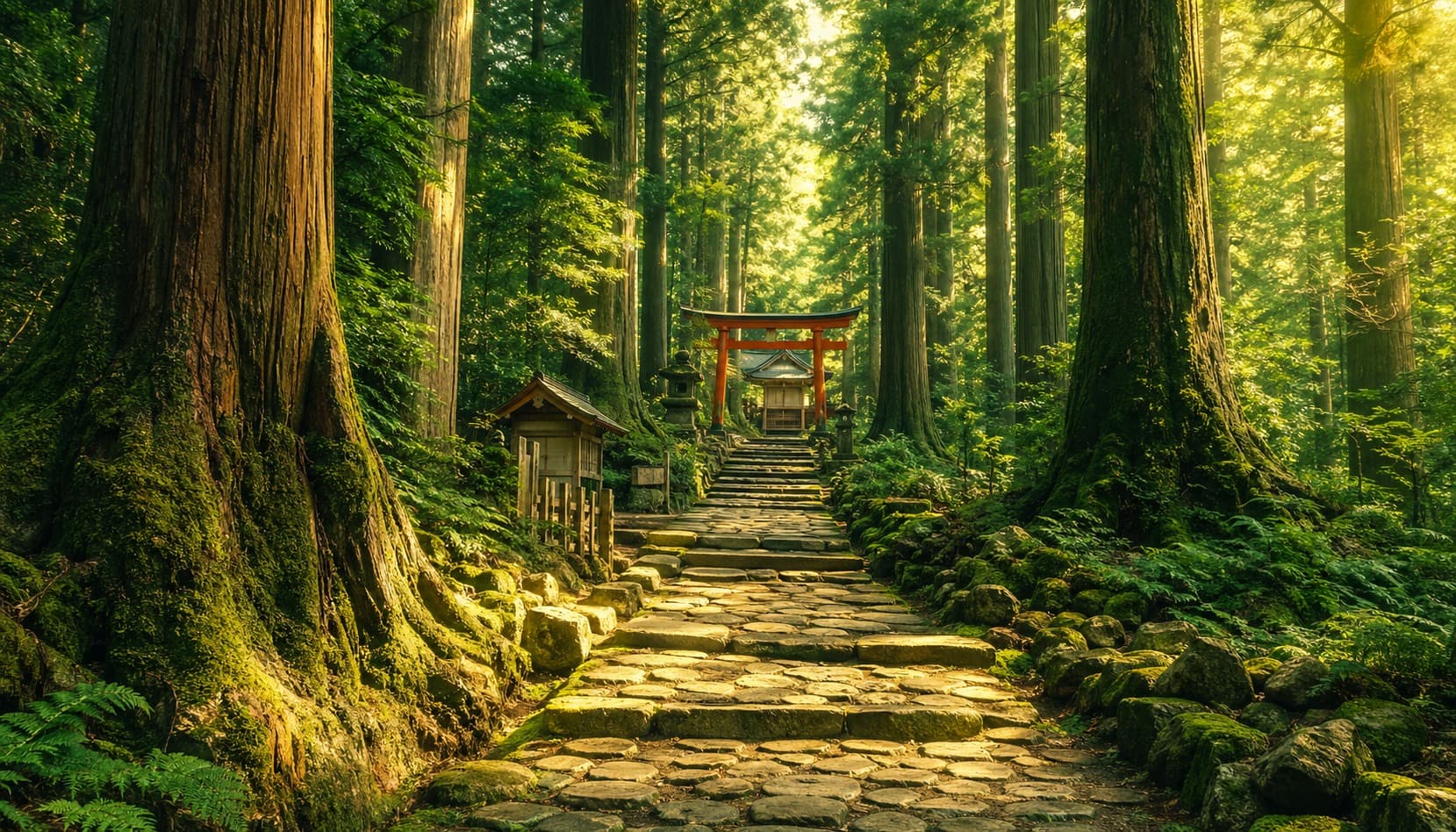
“The emperor's road through ancient cedar and mist”
- ·Takijiri-oji gateway — the ceremonial entrance to the sacred mountains
- ·Dainichi-goe pass — cloud-forest trail at the ridge, ancient moss on stone
- ·Kumano Hongu Taisha — rebuilt after 1889 floods, the spiritual heart of the Kumano trinity
Kohechi (Small Route)
70km · 4 daysKōyasan → Kumano Hongu Taisha · Difficulty ★★★★★
“Between two sacred worlds, in a silence that listens”
- ·Kōyasan departure at dawn — leaving the temple town in morning mist
- ·Three mountain passes over 1,000m — Omata-tōge, Miura-tōge, Nishizaka-tōge
- ·Near-total solitude for days — the path that filters the casual from the committed
Iseji (Ise Route)
170km · 7 daysIse Grand Shrine → Kumano Nachi Taisha · Difficulty ★★★☆☆
“Following Japan's spiritual axis from the sun goddess to the forest gods”
- ·Ise Grand Shrine departure — leaving Amaterasu's domain to seek the forest gods
- ·Magose-tōge pass — a stone-paved climb through cedar forest, unchanged for centuries
- ·Nachi Waterfall (133m) — Japan's tallest waterfall, sacred to Kumano's water deity
Ohechi (Coastal Route)
170km · 7 daysTanabe → Kumano Nachi Taisha · Difficulty ★★★☆☆
“Pacific cliffs, fishing harbors, and headland shrines where the divine feels close”
- ·Kushimoto Cape — Japan's southernmost shrine, Pacific crashing on three sides
- ·Katsuura fishing port — tuna market at dawn, pilgrims among fishermen
- ·Shingu's Hayatama Taisha — one of the Kumano trinity, where rivers meet the sea
About the Route
The Nakahechi is the most sacred of the Kumano Kodo routes and the one most deeply woven into Japanese religious history, used since the 10th century when emperors, empresses, and nobles undertook the Kumano Mōde pilgrimage to venerate the three Grand Shrines of Kumano. Emperor Kazan, who abdicated in 986 to become a wandering monk, is credited with popularizing this route, and the imperial family made the pilgrimage over a hundred times across the Heian and Kamakura periods. The path winds through ancient cedar and cypress forests, past stone-paved climbs worn smooth by a thousand years of sandaled feet, and through moss-draped oji shrine stations where pilgrims have paused in prayer for centuries. A modern pilgrim walking the Nakahechi enters a world of layered time — where Shinto and Buddhist beliefs interweave as naturally as the mist through the Kii Peninsula's mountains, and where each step carries the weight and the freedom of sacred tradition.
Key Waypoints
Takijiri-oji
0km from start · 80mOne of the Five Major Oji and sacred gateway to the Kumano pilgrimage. Imperial purification rituals were performed here. Stamp stand in front of Kumano Kodo-kan, beside entrance.
Osakamoto-oji
9.5km from start · 360mOji at Osakamoto (said to be the origin of the name 'Osaka'). Once an oji shrine in a pass-crossing settlement. Stamp at oji ruins along the trail.
Jagata Jizo
23.5km from start · 440mHall housing a serpent-shaped Jizo Bodhisattva statue. Pilgrims continuously pray here for safe travels. Stamp beside entrance of Jagata Jizo hall.
Fushiogami-oji
31km from start · 350m'Prostrate worship' — the first point where Hongu Taisha becomes visible. Pilgrims fell to their knees in gratitude at the sight. Stamp at the viewpoint.
Kawa-no-Kodou (River Boat Center)
40km from start · 30mSacred water road down the Kumano River. The only World Heritage-listed river pilgrimage route. Imperial families used this waterway during the Heian period. Stamp at the boarding dock.
Kowase Ferry Crossing Ruins
64km from start · 60mSite of a former ferry crossing on the Kumano River. The river marked the boundary between sacred and secular worlds. Stamp near the ferry ruins.
Ichinono-oji
73km from start · 100mNamed for a market field (ichi-no-no) at the foot of Nachisan. This oji appears in records of Retired Emperor Go-Shirakawa’s Kumano pilgrimage procession. Stamp beside the stone monument at oji ruins.
Jizo Tea House Ruins
82km from start · 680mTea house ruins along the Ogumotori-goe trail. A Jizo Bodhisattva statue watches over travelers. A precious rest point on this steep mountain path. Stamp near the tea house ruins.
41 waypoints total · Sacred Trails app contains full detail for every waypoint.
Points of Interest
Takahara Rest House
· teahouseRest stop with views. Vending machines, WC. Open daylight hours
Chikatsuyu Rest Area
· teahouseMinshuku area with shop and vending machines. Stamp station
Nonaka-no-Ipposugi
· teahouseHistoric single cedar tree rest point. Water available
Hosshinmon-oji Rest
· teahouseMajor oji (sub-shrine). Stamp and rest bench. Vending machine
Fuente Takijiri
· waterSourceWater tap at trailhead visitor center
Fuente Chikatsuyu
· waterSourcePotable water at community center
Accommodation
Town lodging summary
8 listed staysKoguchi
2 stays
Rates vary; record your own price notes.
Chikatsuyu
2 stays
Rates vary; record your own price notes.
Yunomine Onsen
2 stays
Rates vary; record your own price notes.
Takahara
1 stay
Rates vary; record your own price notes.
Nachisan
1 stay
Rates vary; record your own price notes.
Koguchi Shizen-no-Ie
Koguchi
Rate varies
Kiri-no-Sato Takahara Lodge
Takahara
Rate varies
Minshuku Chikatsuyu
Chikatsuyu
Rate varies
Minshuku Nakano
Chikatsuyu
Rate varies
Minshuku Momofuku
Koguchi
Rate varies
Mitaki Sanso
Nachisan
Rate varies
Ryokan Adumaya
Yunomine Onsen
Rate varies
Minshuku Yamane
Yunomine Onsen
Rate varies
Data source
Kumano Travel (kumano-travel.com)
Lodging data is sourced from Kumano Travel, the official booking platform for the Kumano Kodō. Some lodging requires advance reservation. Verify availability and prices directly.
Rates vary; use your own price notes and verify availability directly before your trip.
⚠️ Before You Go
Best avoid
July–August (high humidity and heat in the Kii Peninsula forest; tsuyu rainy season in June)
Weather risk
Typhoon season June–October; heavy rainfall can cause trail closures and bridge damage
Mobile signal
Limited signal on most interior sections — download offline maps before departure
Cash
Most teahouses and oji shrines require cash; carry ¥10,000+
Note
The classic Kumano Kodo route — demanding on the Kogumotori-goe sections with 1,200 m+ of daily elevation
Recommended to carry
Navigate the Kumano Nakahechi (Middle Route) Offline
Stage-by-stage navigation, waypoint history, and lodging data — all offline in Sacred Trails. Free to download with route packs for the trails you walk.