Vía de la Plata (Silver Route)
1000km pilgrimage route in Spain
Distance
1000km
Duration
40 days
Difficulty
Very Challenging
Certification
Compostela
Start → End
Seville → Santiago de Compostela
Planning Snapshot
Distance
1000km
Typical duration
40 days
Average day
~25km/day
Difficulty
Very Challenging
Best months
February–May, September–November
Certificate minimum
100km walking
Lodging density
Low
Resupply
Hard
Access
Fly into Seville (SVQ) — AVE high-speed train from Madrid in 2.5 hours.
Is this route a good fit?
Best for
Solitude & full challenge
Time commitment
40 walking days at about 25km/day
Lodging and resupply
Low lodging · Hard resupply
Why use Sacred Trails
Offline stages, waypoint stories, lodging notes, and route context stay available when mobile signal drops.
Rough Distance Planner
Use this as a rough distance sketch before detailed planning: 40 walking days across 1000km, averaging about 25km per day. Adjust for real stages, terrain, rest days, weather, opening seasons, and lodging availability before booking.
Daily target
25km
Route style
Low lodging · Hard resupply
| Day | Distance | Total | Route / lodging reference | |
|---|---|---|---|---|
| 1 | Walk | 25km | 25km | Castilblanco de los Arroyos · Guillena (1 listed stays) |
| 2 | Walk | 25km | 50km | Castilblanco de los Arroyos · Guillena (1 listed stays) |
| 3 | Walk | 25km | 75km | Almaden de la Plata · Guillena (1 listed stays) |
| 4 | Walk | 25km | 100km | Monesterio · Zafra (1 listed stays) |
| 5 | Walk | 25km | 125km | Fuente de Cantos · Zafra (1 listed stays) |
| 6 | Walk | 25km | 150km | Fuente de Cantos · Zafra (1 listed stays) |
| 7 | Walk | 25km | 175km | Zafra · Zafra (1 listed stays) |
| 8 | Walk | 25km | 200km | Villafranca de los Barros · Zafra (1 listed stays) |
| 9 | Walk | 25km | 225km | Merida · Zafra (1 listed stays) |
| 10 | Walk | 25km | 250km | Merida · Zafra (1 listed stays) |
| 11 | Walk | 25km | 275km | Merida · Zafra (1 listed stays) |
| 12 | Walk | 25km | 300km | Alcuescar · Zafra (1 listed stays) |
| 13 | Walk | 25km | 325km | Caceres · Zafra (1 listed stays) |
| 14 | Walk | 25km | 350km | Caceres · Zafra (1 listed stays) |
| 15 | Walk | 25km | 375km | Canaveral · Zafra (1 listed stays) |
| 16 | Walk | 25km | 400km | Galisteo · Zafra (1 listed stays) |
| 17 | Walk | 25km | 425km | Aldeanueva del Camino · Zamora (1 listed stays) |
| 18 | Walk | 25km | 450km | Aldeanueva del Camino · Zamora (1 listed stays) |
| 19 | Walk | 25km | 475km | Banos de Montemayor · Zamora (1 listed stays) |
| 20 | Walk | 25km | 500km | Fuenterroble de Salvatierra · Zamora (1 listed stays) |
| 21 | Walk | 25km | 525km | Fuenterroble de Salvatierra · Zamora (1 listed stays) |
| 22 | Walk | 25km | 550km | Fuenterroble de Salvatierra · Zamora (1 listed stays) |
| 23 | Walk | 25km | 575km | Salamanca · Zamora (1 listed stays) |
| 24 | Walk | 25km | 600km | El Cubo de Tierra del Vino · Zamora (1 listed stays) |
| 25 | Walk | 25km | 625km | Zamora · Zamora (1 listed stays) |
| 26 | Walk | 25km | 650km | Zamora · Zamora (1 listed stays) |
| 27 | Walk | 25km | 675km | Granja de Moreruela · Zamora (1 listed stays) |
| 28 | Walk | 25km | 700km | Benavente · Zamora (1 listed stays) |
| 29 | Walk | 25km | 725km | Alija del Infantado · Zamora (1 listed stays) |
| 30 | Walk | 25km | 750km | Alija del Infantado · Zamora (1 listed stays) |
| 31 | Walk | 25km | 775km | La Baneza · Zamora (1 listed stays) |
| 32 | Walk | 25km | 800km | Astorga · Zamora (1 listed stays) |
| 33 | Walk | 25km | 825km | Ponferrada · Zamora (1 listed stays) |
| 34 | Walk | 25km | 850km | Ponferrada · Zamora (1 listed stays) |
| 35 | Walk | 25km | 875km | Ponferrada · Zamora (1 listed stays) |
| 36 | Walk | 25km | 900km | O Cebreiro · Zamora (1 listed stays) |
| 37 | Walk | 25km | 925km | Sarria · Zamora (1 listed stays) |
| 38 | Walk | 25km | 950km | Sarria · Zamora (1 listed stays) |
| 39 | Walk | 25km | 975km | Portomarin · Zamora (1 listed stays) |
| 40 | Walk | 25km | 1000km | Santiago de Compostela · Zamora (1 listed stays) |
| Total days | 1000km | 40 | ||
Distances are averaged. Route markers use the nearest ordered waypoint to each rough segment; lodging references are supporting town data, not recommended overnight stops or confirmed availability.
About the Route
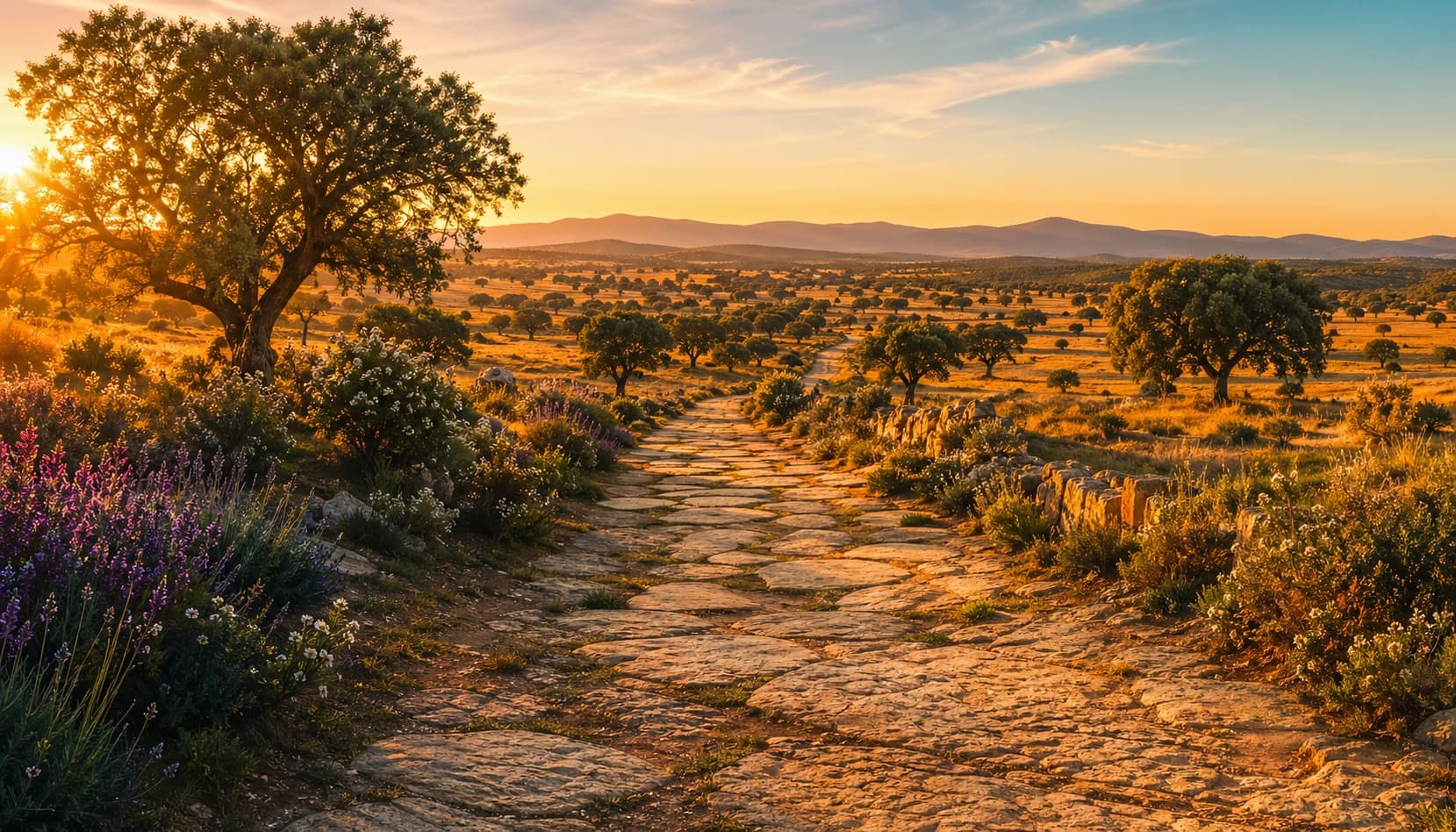
The Vía de la Plata follows one of the most important roads in Roman Iberia — the Via Augusta — which carried silver from the mines of Extremadura northward to the port cities of the empire. With 1,000 kilometers from Seville to Santiago, it is the longest Camino route and one of the most solitary: for days at a time, a pilgrim may walk through the vast, sun-bleached plains of Extremadura and Castile without seeing another soul. Along the way lie Roman bridges intact after two millennia, the white-walled city of Mérida with its amphitheater and triumphal arch, and medieval towns where the pilgrim can feel genuinely lost in time. To walk the Plata is to undergo an endurance that reshapes the body and empties the mind — and to emerge at the Atlantic end of Spain transformed by one of the great solitary journeys left on earth.
Key Waypoints
Sevilla
0km from start · 11mBegin the Vía de la Plata at the world's largest Gothic cathedral (UNESCO), with Columbus's tomb inside. The Giralda tower was a 12th-century Almohad minaret transformed into a bell tower. The Real Alcázar palace is the oldest royal palace still in use in Europe. The Barrio de Santa Cruz, the former Jewish quarter, is a labyrinth of whitewashed lanes. Summer heat warning: temperatures regularly exceed 40°C — start before dawn.
Almaden de la Plata
75km from start · 480mDespite its name echoing Almadén (mercury mines), this village's 'plata' refers to the Via de la Plata road itself. The Romans mined silver and copper in these Sierra Norte hills, and a well-preserved section of the original Via Augusta road surface — with original basalt paving and a milestone inscribed to Emperor Augustus — survives nearby.
Villafranca de los Barros
200km from start · 330mImportant agricultural town in the Tierra de Barros, one of Extremadura's most productive wine regions. The sandy 'barro' soils give the region its name and produce the characteristic wines. The 16th-century collegiate church of Santa María del Valle is a significant Renaissance monument. The town's ceramic and wine traditions are deeply intertwined. Important resupply stop on the long stretch across the Extremaduran meseta.
Canaveral
365km from start · 360mA hilltop village with views over the Tajo River gorge and the Alcántara reservoir, 20km from the Puente de Alcántara — the greatest Roman bridge in Spain, built under Emperor Trajan around 106 CE. The Vía de la Plata crosses this wild granite and holm oak terrain with its original Roman alignment almost perfectly preserved.
Fuenterroble de Salvatierra
510km from start · 930mRemote Castilian village at 1,033m on the Silver Route, famous for its legendary parish priest Blas who dedicated his life to welcoming pilgrims. His handwritten pilgrim register became renowned throughout Spain. A deeply human stage on the Via.
Zamora
640km from start · 652mThe 'Romanesque Museum' city boasting 24 Romanesque churches — the highest concentration in the world for its size — built between the 11th and 13th centuries. The cathedral's Byzantine-inspired ribbed dome (1174) is unique in Spain. The city walls and the castle overlook the Douro River. The Holy Week processional sculptures (pasos) are considered among Spain's finest religious art. Traditional filigree silverwork is a local craft.
La Baneza
760km from start · 770mMarket town in the fertile Órbigo-Tuerto basin of León. The Via de la Plata enters the final Leonese plain before Astorga here. The Baroque Church of Santa María and lively market square make it a comfortable rest stop on the Silver Route.
Sarria
940km from start · 453mThe most popular starting point for pilgrims seeking the minimum 100km required for the Compostela certificate — the town is exactly 111km from Santiago. The medieval old town climbs a steep hill crowned by the 13th-century Monastery of La Magdalena. The Romanesque Church of O Salvador and the castle tower are important monuments. Sarria marks a noticeable increase in fellow pilgrims on the trail.
30 waypoints total · Sacred Trails app contains full detail for every waypoint.
Points of Interest
Albergue Sevilla
· albergueStarting point. Near Cathedral. Credential office
Farmacia Sevilla Centro
· pharmacyAvenida de la Constitucion. Open 9-21h
Restaurante Sevilla
· foodBarrio Santa Cruz. Tapas and gazpacho
Albergue Guillena
· albergueFirst stage stop. Municipal. 20 beds
Albergue Zafra
· albergueParador town. Municipal albergue. 30 beds
Restaurante Zafra
· foodPlaza Grande. Extremaduran cuisine, migas
Accommodation
Town lodging summary
9 listed staysGuillena
1 stay
Rates vary; record your own price notes.
Calzadilla de los Barros
1 stay
Rates vary; record your own price notes.
Zafra
1 stay
Rates vary; record your own price notes.
Mérida
1 stay
Rates vary; record your own price notes.
Aldea del Cano
1 stay
Rates vary; record your own price notes.
Valdesalor
1 stay
Rates vary; record your own price notes.
Cáceres
1 stay
Rates vary; record your own price notes.
Zamora
1 stay
Rates vary; record your own price notes.
Albergue Municipal de Guillena
Guillena
Rate varies
Albergue de Peregrinos de Calzadilla de los Barros
Calzadilla de los Barros
Rate varies
Albergue de Peregrinos de Zafra
Zafra
Rate varies
Albergue de Peregrinos Molino de Pancaliente
Mérida
Rate varies
Albergue Municipal Miliario del Verdinal
Aldea del Cano
Rate varies
Albergue de Peregrinos de Valdesalor
Valdesalor
Rate varies
Albergue Turístico Las Veletas
Cáceres
Rate varies
Albergue de Peregrinos de Zamora
Zamora
Rate varies
Data source
Gronze.com (community-maintained)
Lodging data is sourced from Gronze.com, a community-maintained database of Camino accommodation. Prices, availability, and seasonal closures change — always verify directly with the accommodation before your trip.
Showing 8 of 9 · Rates vary; use your own price notes and verify availability directly before your trip.
⚠️ Before You Go
Best avoid
June–August (extreme heat on the Extremadura plains — up to 42°C)
Weather risk
Summer heat the primary danger; some stages have no water or shade for 25+ km
Mobile signal
Long stretches with no services or signal in southern Extremadura
Cash
Remote villages in Extremadura rarely have ATMs — carry €60+
Note
The longest Camino (1,000 km); the southern section in summer is among the harshest conditions on any route
Recommended to carry
Navigate the Vía de la Plata (Silver Route) Offline
Stage-by-stage navigation, waypoint history, and lodging data — all offline in Sacred Trails. Free to download with route packs for the trails you walk.