Camino Fisterra-Muxía
87km pilgrimage route in Spain
Distance
87km
Duration
3 days
Difficulty
Easy
Certification
fisterrana
Start → End
Santiago de Compostela → Cabo Fisterra
Planning Snapshot
Distance
87km
Typical duration
3 days
Average day
~29km/day
Difficulty
Easy
Best months
April–October
Lodging density
Medium
Resupply
Moderate
Access
Starts in Santiago de Compostela — fly into SCQ airport. Most pilgrims walk this as an extension after completing another Camino.
Is this route a good fit?
Best for
Post-Camino extension
Time commitment
3 walking days at about 29km/day
Lodging and resupply
Medium lodging · Moderate resupply
Why use Sacred Trails
Offline stages, waypoint stories, lodging notes, and route context stay available when mobile signal drops.
Rough Distance Planner
Use this as a rough distance sketch before detailed planning: 3 walking days across 87km, averaging about 29km per day. Adjust for real stages, terrain, rest days, weather, opening seasons, and lodging availability before booking.
Daily target
29km
Route style
Medium lodging · Moderate resupply
| Day | Distance | Total | Route / lodging reference | |
|---|---|---|---|---|
| 1 | Walk | 29km | 29km | Verify lodging directly |
| 2 | Walk | 29km | 58km | Verify lodging directly |
| 3 | Walk | 29km | 87km | Verify lodging directly |
| Total days | 87km | 3 | ||
Distances are averaged. Route markers use the nearest ordered waypoint to each rough segment; lodging references are supporting town data, not recommended overnight stops or confirmed availability.
About the Route
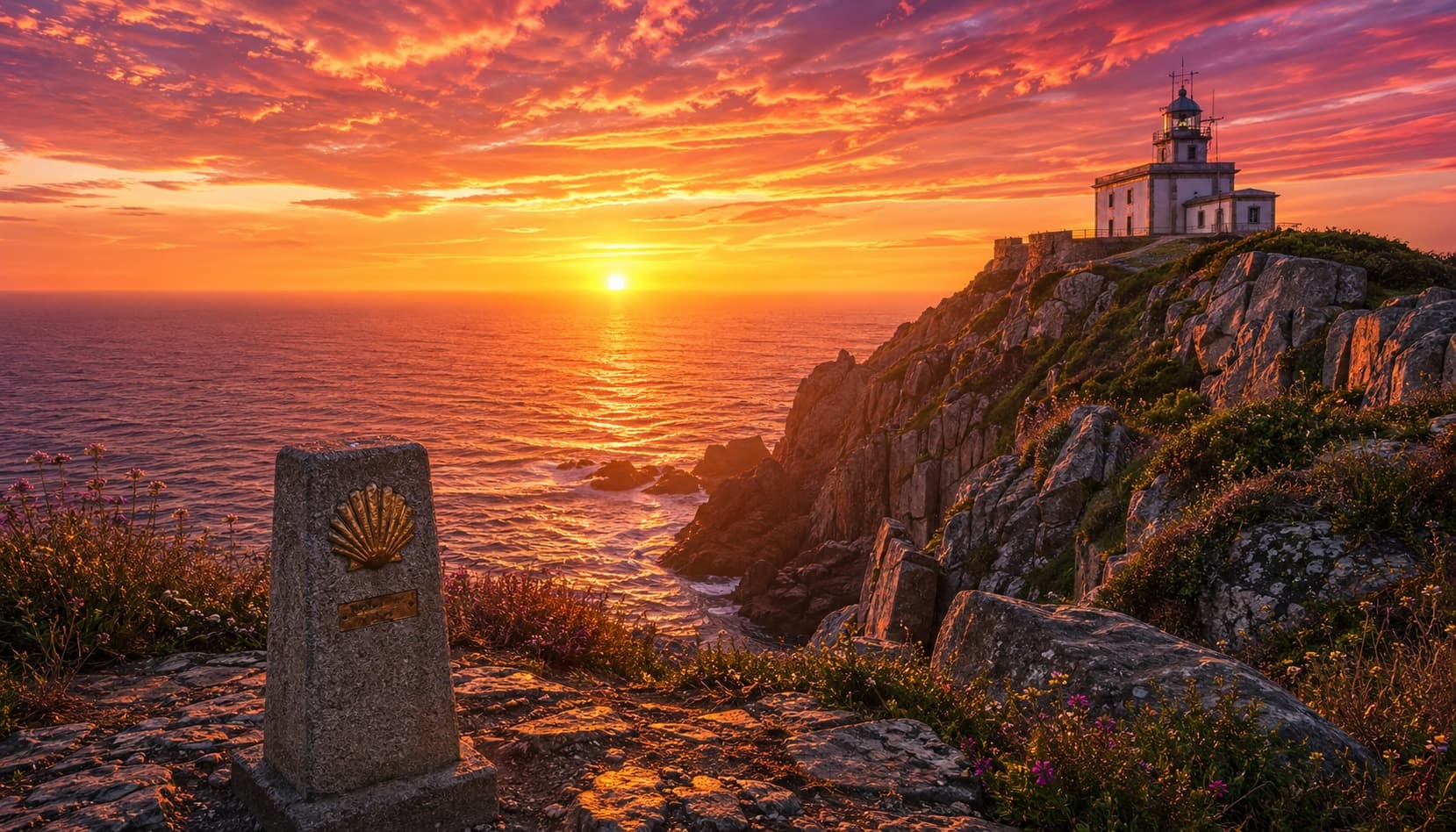
The Camino Fisterra-Muxía is the pilgrim extension that continues west from Santiago de Compostela to the rugged Atlantic coast of Galicia. Walking approximately 87 km over 3 days, pilgrims pass through dense Galician forests, traditional stone villages, and dramatic coastal cliffs before reaching Cabo Fisterra — historically believed to be the edge of the known world — and the mystical sanctuary of Muxía. The route awards the Fisterrana certificate and offers a profound sense of completion at the lighthouse marking kilometre 0.00.
Points of Interest
Cape Fisterra Lighthouse (Faro de Fisterra)
· viewpointThe iconic lighthouse standing at kilometre 0.00 on the Camino, perched 143 metres above the Atlantic Ocean on Monte Facho. Built in 1853, it marks the symbolic end of the world for pilgrims. The km 0.00 stone marker is located just outside the lighthouse gate and is one of the most photographed spots on any Camino route.
Shoe-Burning Stone (Pedra dos Zapatos)
· landmarkThe ancient ritual site near the Fisterra lighthouse where pilgrims have traditionally burned their boots or socks at the end of the Camino as a rite of symbolic purification and renewal. While officially discouraged due to fire risks, small ceremonies continue here. Some pilgrims place stones or leave mementos instead.
Santuario da Virxe da Barca (Muxía)
· churchThe Romanesque sanctuary of Our Lady of the Boat sits dramatically on the rocky headland of Punta da Barca in Muxía, battered by Atlantic waves. Legend holds that the Virgin Mary arrived here by stone boat to encourage the apostle Saint James in his evangelisation. The surrounding rocks — Pedra de Abalar, Pedra dos Cadrís — are venerated for healing properties. Issues the Muxiana certificate.
Ponte Maceira Medieval Bridge
· landmarkA graceful 14th-century five-arch granite bridge over the Tambre River, considered one of Galicia's finest medieval bridges. According to legend, the followers of Saint James crossed here carrying his body to Santiago; Queen Lupa's soldiers destroyed it in pursuit but it miraculously rebuilt itself. The chapel of San Brais guards the bridge end.
Olveiroa Village Fountain
· fountainThe village fountain in Olveiroa is one of the most important water points on the entire Camino Fisterra, as it is often the last reliable water source before the long descent to the Atlantic coast. Medieval pilgrims would have filled their gourd flasks here before tackling the remaining stages to Fisterra or Muxía.
Church of Santa María das Areas (Fisterra)
· churchA Romanesque-Gothic church just south of Fisterra town, housing a revered 12th-century image of Christ — the Cristo da Barba Dourada (Christ of the Golden Beard). The church was a major pilgrimage destination in its own right during the medieval period. Its Romanesque portal and stone carving are outstanding examples of Galician Romanesque art.
Accommodation
Town lodging summary
8 listed staysNegreira
2 stays
Rates vary; record your own price notes.
Olveiroa
2 stays
Rates vary; record your own price notes.
Vilaserío
1 stay
Rates vary; record your own price notes.
Dumbría
1 stay
Rates vary; record your own price notes.
Cee
1 stay
Rates vary; record your own price notes.
Corcubión
1 stay
Rates vary; record your own price notes.
Albergue de Peregrinos de Negreira
Negreira
Rate varies
Albergue El Carmen
Negreira
Rate varies
Refugio Municipal de Vilaserío
Vilaserío
Rate varies
Albergue de Peregrinos de Olveiroa
Olveiroa
Rate varies
Albergue Hórreo
Olveiroa
Rate varies
Albergue de Peregrinos O Conco
Dumbría
Rate varies
Albergue A Casa da Fonte
Cee
Rate varies
Albergue de Peregrinos San Roque
Corcubión
Rate varies
Data source
Gronze.com (community-maintained)
Lodging data is sourced from Gronze.com, a community-maintained database of Camino accommodation. Prices, availability, and seasonal closures change — always verify directly with the accommodation before your trip.
Rates vary; use your own price notes and verify availability directly before your trip.
⚠️ Before You Go
Best avoid
December–February (short daylight hours; Atlantic rain)
Weather risk
Coastal wind and rain year-round; cape sections exposed to Atlantic gales
Note
Typically walked after receiving the Compostela — a physically easy extension but emotionally the most powerful
Recommended to carry
Navigate the Camino Fisterra-Muxía Offline
Stage-by-stage navigation, waypoint history, and lodging data — all offline in Sacred Trails. Free to download with route packs for the trails you walk.