Camino del Norte (Northern Way)
820km pilgrimage route in Spain
Distance
820km
Duration
35 days
Difficulty
Challenging
Certification
Compostela
Start → End
Irun → Santiago de Compostela
Planning Snapshot
Distance
820km
Typical duration
35 days
Average day
~23km/day
Difficulty
Challenging
Best months
May–June, September
Certificate minimum
100km walking
Lodging density
Medium
Resupply
Moderate
Access
Train or bus to Irun (Basque Country, Spain) on the French border. Fly into Bilbao (BIO) or San Sebastián (EAS).
Is this route a good fit?
Best for
Wild coast & solitude
Time commitment
35 walking days at about 23km/day
Lodging and resupply
Medium lodging · Moderate resupply
Why use Sacred Trails
Offline stages, waypoint stories, lodging notes, and route context stay available when mobile signal drops.
Rough Distance Planner
Use this as a rough distance sketch before detailed planning: 35 walking days across 820km, averaging about 23km per day. Adjust for real stages, terrain, rest days, weather, opening seasons, and lodging availability before booking.
Daily target
23.4km
Route style
Medium lodging · Moderate resupply
| Day | Distance | Total | Route / lodging reference | |
|---|---|---|---|---|
| 1 | Walk | 23.4km | 23.4km | San Sebastian · Santander (1 listed stays) |
| 2 | Walk | 23.4km | 46.8km | Zarautz · Santander (1 listed stays) |
| 3 | Walk | 23.4km | 70.2km | Deba · Santander (1 listed stays) |
| 4 | Walk | 23.4km | 93.6km | Gernika · Santander (1 listed stays) |
| 5 | Walk | 23.4km | 117km | Gernika · Santander (1 listed stays) |
| 6 | Walk | 23.4km | 140.4km | Gernika · Santander (1 listed stays) |
| 7 | Walk | 23.4km | 163.8km | Bilbao · Santander (1 listed stays) |
| 8 | Walk | 23.4km | 187.2km | Portugalete · Santander (1 listed stays) |
| 9 | Walk | 23.4km | 210.6km | Castro Urdiales · Santander (1 listed stays) |
| 10 | Walk | 23.4km | 234km | Laredo · Santander (1 listed stays) |
| 11 | Walk | 23.4km | 257.4km | Santona · Santander (1 listed stays) |
| 12 | Walk | 23.4km | 280.8km | Santander · Santander (1 listed stays) |
| 13 | Walk | 23.4km | 304.2km | Santander · Santander (1 listed stays) |
| 14 | Walk | 23.4km | 327.6km | Santillana del Mar · Santillana del Mar (1 listed stays) |
| 15 | Walk | 23.4km | 351km | Santillana del Mar · Santillana del Mar (1 listed stays) |
| 16 | Walk | 23.4km | 374.4km | San Vicente de la Barquera · Santillana del Mar (1 listed stays) |
| 17 | Walk | 23.4km | 397.8km | Llanes · Santillana del Mar (1 listed stays) |
| 18 | Walk | 23.4km | 421.2km | Llanes · Santillana del Mar (1 listed stays) |
| 19 | Walk | 23.4km | 444.6km | Ribadesella · Santillana del Mar (1 listed stays) |
| 20 | Walk | 23.4km | 468km | Villaviciosa · Santillana del Mar (1 listed stays) |
| 21 | Walk | 23.4km | 491.4km | Villaviciosa · Santillana del Mar (1 listed stays) |
| 22 | Walk | 23.4km | 514.8km | Villaviciosa · La Caridad (2 listed stays) |
| 23 | Walk | 23.4km | 538.2km | Gijon · La Caridad (2 listed stays) |
| 24 | Walk | 23.4km | 561.6km | Aviles · La Caridad (2 listed stays) |
| 25 | Walk | 23.4km | 585km | Soto de Luina · La Caridad (2 listed stays) |
| 26 | Walk | 23.4km | 608.4km | Soto de Luina · La Caridad (2 listed stays) |
| 27 | Walk | 23.4km | 631.8km | Luarca · La Caridad (2 listed stays) |
| 28 | Walk | 23.4km | 655.2km | La Caridad · La Caridad (2 listed stays) |
| 29 | Walk | 23.4km | 678.6km | Ribadeo · La Caridad (2 listed stays) |
| 30 | Walk | 23.4km | 702km | Lourenza · Ribadeo (2 listed stays) |
| 31 | Walk | 23.4km | 725.4km | Lourenza · Ribadeo (2 listed stays) |
| 32 | Walk | 23.4km | 748.8km | Mondonedo · Ribadeo (2 listed stays) |
| 33 | Walk | 23.4km | 772.2km | Vilalba · Ribadeo (2 listed stays) |
| 34 | Walk | 23.4km | 795.6km | Baamonde · Ribadeo (2 listed stays) |
| 35 | Walk | 24.4km | 820km | Sobrado dos Monxes · Ribadeo (2 listed stays) |
| Total days | 820km | 35 | ||
Distances are averaged. Route markers use the nearest ordered waypoint to each rough segment; lodging references are supporting town data, not recommended overnight stops or confirmed availability.
About the Route
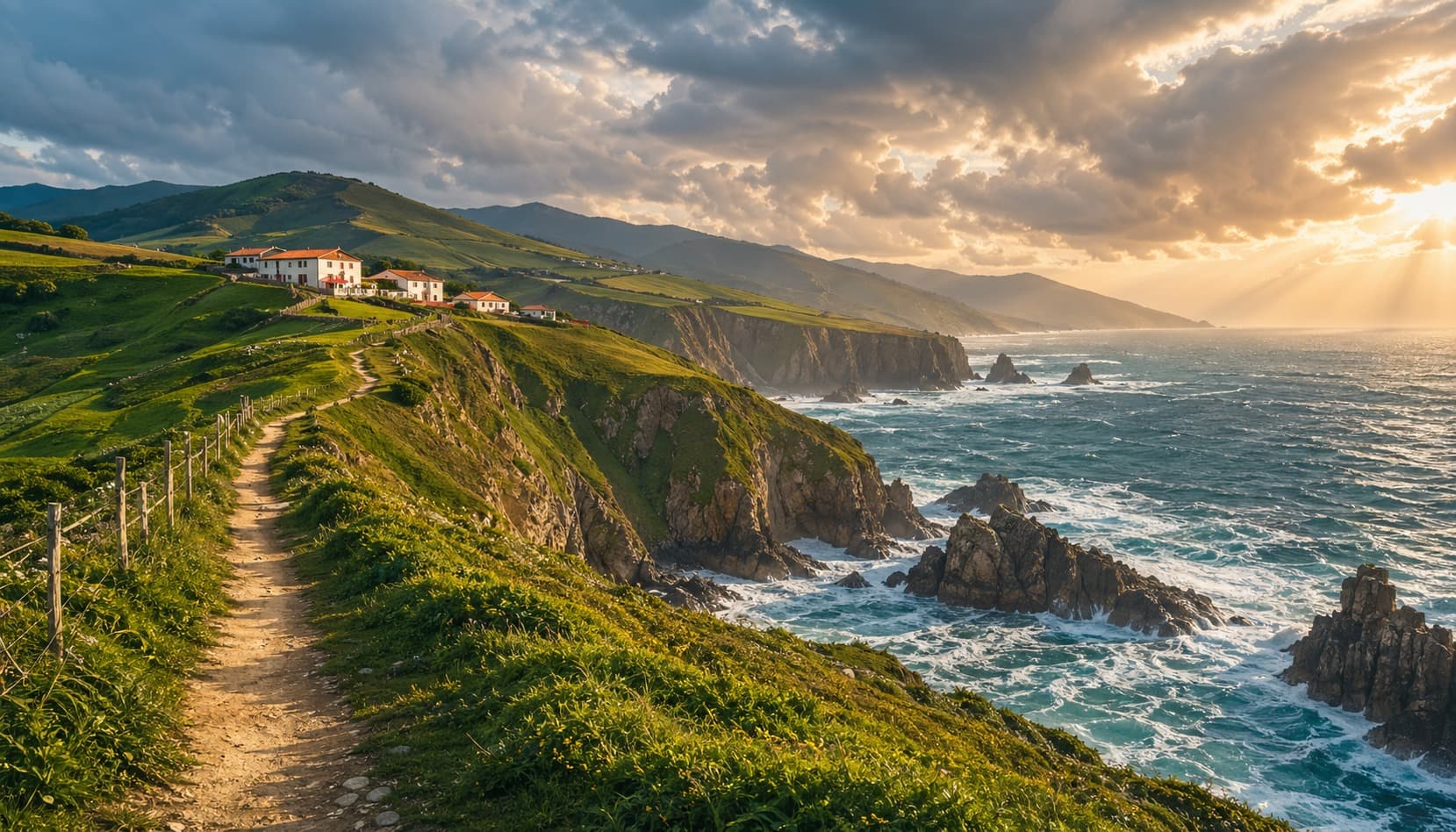
The Camino del Norte is the oldest of all Camino routes — the path chosen by medieval pilgrims when Moorish occupation made the interior of Spain too dangerous to cross. Hugging the wild Cantabrian coastline for over 800 kilometers, it passes through the deeply individual cultures of the Basque Country, Cantabria, and Asturias before arriving in Galicia. The terrain is genuinely demanding: clifftop paths above crashing surf, dense eucalyptus forests, and river estuaries with no shortcuts. The pilgrim who walks the Norte discovers an older, quieter Spain — fishing villages where the Camino is a living tradition, and landscapes so dramatic they seem indifferent to history itself.
Key Waypoints
Irun
0km from start · 10mIrun sits on the Bidasoa River at the French border, at the exact crossing point used by pilgrims since at least the 12th century. The hilltop Ermita de San Marcial recalls the 1522 Battle of San Marcial, where Spanish forces repelled the last French attempt to take Navarre. The Church of Santa María del Juncal houses a remarkable Renaissance-period Black Madonna venerated by Basque fishermen.
Deba
69km from start · 5mBasque coastal town where the Camino del Norte begins its dramatic clifftop sections. Deba's Gothic Church of Santa María la Real and its pristine beach make it a scenic stage start. The coastal path ahead offers spectacular Atlantic views.
Portugalete
175km from start · 5mIndustrial port town at the mouth of the Nervión River, famous for the Vizcaya Bridge — a UNESCO World Heritage transporter bridge built in 1893, the world's oldest of its kind. Pilgrims cross the river here to continue west along the coast.
Santander
295km from start · 5mSantander's Cathedral is built on two levels — the lower crypt church of Santísimo Cristo dates to the 13th century and houses the relics of Cantabrian martyrs Saints Emeterius and Celedonius, venerated since Roman times. The city was historically a key embarkation point for English and Flemish pilgrims sailing to join the Camino on Spain's north coast.
Ribadesella
455km from start · 5mWhere the Sella River meets the Cantabrian Sea. Tito Bustillo Cave has 20,000-year-old paleolithic art. Famous international kayak descent.
Soto de Luina
595km from start · 40mA scattered hamlet on the Asturian clifftops, Soto de Luina marks the approach to the wild western coast where the Camino del Norte runs closest to the sea. The parish church of Santa María preserves a Baroque retable carved in local wood. Traditional hórreos (stone-pillared granaries) dot the fields, unchanged in form since the medieval Asturian kingdom used them to keep grain from rats and damp.
Lourenza
720km from start · 75mSmall Galician town in the Masma River valley, home to the impressive Benedictine Monastery of San Salvador de Lourenzá, founded in the 10th century. The baroque façade and its relic of Santo Estevo attract both pilgrims and religious devotees.
Sobrado dos Monxes
815km from start · 500mMassive Cistercian monastery (10th-century origins) with three remarkable cloisters. Monks offer pilgrim accommodation and evening prayers.
31 waypoints total · Sacred Trails app contains full detail for every waypoint.
Points of Interest
Albergue Irún
· albergueStarting point. Pilgrim office for credential. 32 beds
Restaurante Irún
· foodBasque pintxos. San Juan area
Albergue San Sebastián
· albergueOndarreta area. 60 beds. Open Apr-Oct
Farmacia San Sebastián
· pharmacyParte Vieja. Full pharmacy
Restaurante San Sebastián
· foodWorld-class pintxos bars. Calle 31 de Agosto
Albergue Zarautz
· albergueCoastal town. Beach albergue. 30 beds
Accommodation
Town lodging summary
9 listed staysLa Caridad
2 stays
Rates vary; record your own price notes.
Ribadeo
2 stays
Rates vary; record your own price notes.
Irún
1 stay
Rates vary; record your own price notes.
Santander
1 stay
Rates vary; record your own price notes.
Santillana del Mar
1 stay
Rates vary; record your own price notes.
Avilés
1 stay
Rates vary; record your own price notes.
Tol
1 stay
Rates vary; record your own price notes.
Albergue de Peregrinos Jakobi
Irún
Rate varies
Albergue de Peregrinos Santos Mártires
Santander
Rate varies
Albergue El Convento
Santillana del Mar
Rate varies
Albergue de Peregrinos Pedro Solís
Avilés
Rate varies
Albergue de Peregrinos de La Caridad
La Caridad
Rate varies
Albergue La Xana
La Caridad
Rate varies
Albergue de Peregrinos de Tol
Tol
Rate varies
Albergue de Peregrinos de Ribadeo
Ribadeo
Rate varies
Data source
Gronze.com (community-maintained)
Lodging data is sourced from Gronze.com, a community-maintained database of Camino accommodation. Prices, availability, and seasonal closures change — always verify directly with the accommodation before your trip.
Showing 8 of 9 · Rates vary; use your own price notes and verify availability directly before your trip.
⚠️ Before You Go
Best avoid
November–February (persistent rain, cliff paths become slippery)
Weather risk
Heavy rainfall year-round on the Basque and Cantabrian coast; fog on cliff sections is common
Mobile signal
Limited signal in rural Asturias and some Galician coastal sections
Cash
Many fishing village bars and albergues are cash-only; carry €40+
Note
Significantly harder than Camino Francés — cumulative elevation over the full route exceeds 15,000 m
Recommended to carry
Navigate the Camino del Norte (Northern Way) Offline
Stage-by-stage navigation, waypoint history, and lodging data — all offline in Sacred Trails. Free to download with route packs for the trails you walk.