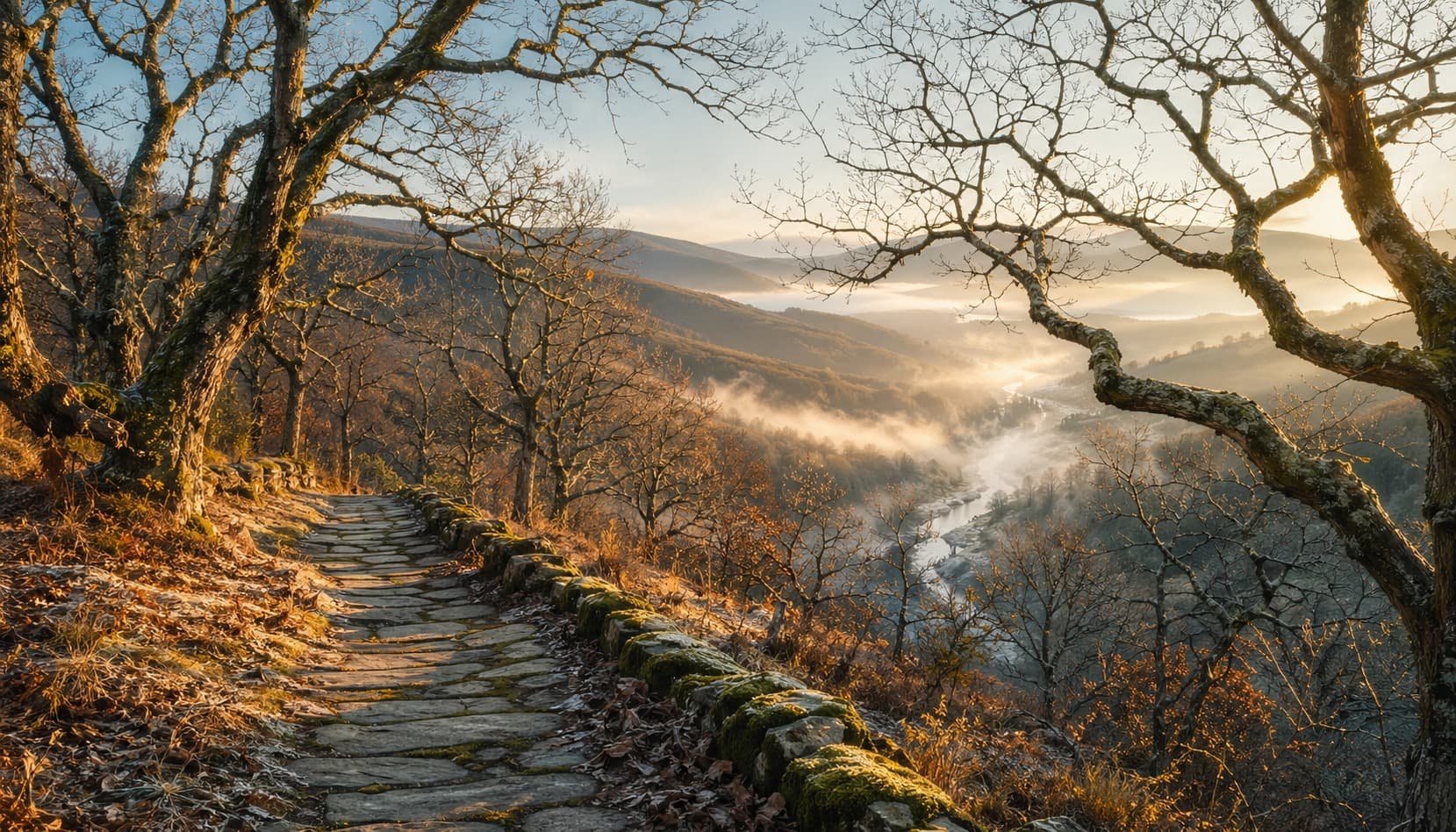
Camino de Invierno
263km pilgrimage route in Spain
Distance
263km
Duration
10 days
Difficulty
Moderate
Certification
Compostela
Start → End
→
Planning Snapshot
Distance
263km
Typical duration
10 days
Average day
~26km/day
Difficulty
Moderate
Best months
May–October
Lodging density
Low
Resupply
Moderate
Access
Bus or train to Ponferrada from León or Madrid, then onward local transport. Fly into León (LEN) or Madrid (MAD).
Is this route a good fit?
Best for
Wild Galicia & solitude
Time commitment
10 walking days at about 26km/day
Lodging and resupply
Low lodging · Moderate resupply
Why use Sacred Trails
Offline stages, waypoint stories, lodging notes, and route context stay available when mobile signal drops.
Rough Distance Planner
Use this as a rough distance sketch before detailed planning: 10 walking days across 263km, averaging about 26km per day. Adjust for real stages, terrain, rest days, weather, opening seasons, and lodging availability before booking.
Daily target
26.3km
Route style
Low lodging · Moderate resupply
| Day | Distance | Total | Route / lodging reference | |
|---|---|---|---|---|
| 1 | Walk | 26.3km | 26.3km | Verify lodging directly |
| 2 | Walk | 26.3km | 52.6km | Verify lodging directly |
| 3 | Walk | 26.3km | 78.9km | Verify lodging directly |
| 4 | Walk | 26.3km | 105.2km | Verify lodging directly |
| 5 | Walk | 26.3km | 131.5km | Verify lodging directly |
| 6 | Walk | 26.3km | 157.8km | Verify lodging directly |
| 7 | Walk | 26.3km | 184.1km | Verify lodging directly |
| 8 | Walk | 26.3km | 210.4km | Verify lodging directly |
| 9 | Walk | 26.3km | 236.7km | Verify lodging directly |
| 10 | Walk | 26.3km | 263km | Verify lodging directly |
| Total days | 263km | 10 | ||
Distances are averaged. Route markers use the nearest ordered waypoint to each rough segment; lodging references are supporting town data, not recommended overnight stops or confirmed availability.
About the Route
The Camino de Invierno — the Winter Way — was born out of necessity, carved by medieval pilgrims who dared not face the snow-choked passes of the Pyrenees in the coldest months. Branching south from Ponferrada, it winds through the forgotten heart of Galicia: the slate gorges of Quiroga, the vine-terraced valleys of Monforte de Lemos, and the mist-wrapped hills of Chantada. Far from the crowded Francés, this route offers an encounter with a wilder, quieter Spain — ancient stone bridges, abandoned monasteries, and the slow rhythm of a land that time has barely touched. Walking the Invierno is an act of solitude and surrender, tracing the footsteps of those who chose the harder road when all easier paths were closed.
Points of Interest
Templar Castle of Ponferrada
· castleOne of the largest Templar fortresses in Spain, built in the 12th century. Houses the Templum Libri collection of rare religious manuscripts. The iconic starting landmark of the Camino de Invierno.
Iglesia de Santo Tomás de las Ollas
· church10th-century Mozarabic chapel on a hilltop outside Ponferrada. One of the finest examples of Mozarabic architecture in Spain, featuring a unique horseshoe-arch apse.
Las Médulas UNESCO Site
· monumentThe largest open-pit gold mine of the Roman Empire, designated a UNESCO World Heritage Site. The dramatic rust-red landscape of eroded rock pillars and chestnut forests is the highlight of stage 1.
Sil River Canyon Viewpoint
· viewpointStunning viewpoint overlooking the dramatic Sil River canyon between Quiroga and Monforte. The sheer rock walls and deep gorge carved by the Sil through the Ribeira Sacra are one of Spain's most spectacular natural landscapes.
Monastery of San Vicente do Pino
· monumentA Benedictine monastery dating to the 10th century, now converted into the Parador Nacional de Monforte de Lemos. Features a Renaissance façade, Gothic interior with elaborate vaults, and a Baroque organ. Crowns the hill above Monforte de Lemos.
Ribeira Sacra Wine Terraces
· viewpointThe dramatic terraced vineyards of the Ribeira Sacra, clinging almost vertically to the canyon walls above the Miño and Sil rivers. This DOC wine region produces exceptional Mencía red wines. Stage 7 passes through this spectacular landscape.
Accommodation
Town lodging summary
12 listed staysMonforte de Lemos
3 stays
Rates vary; record your own price notes.
Ponferrada
2 stays
Rates vary; record your own price notes.
Chantada
2 stays
Rates vary; record your own price notes.
Quiroga
1 stay
Rates vary; record your own price notes.
O Barco de Valdeorras
1 stay
Rates vary; record your own price notes.
Lalín
1 stay
Rates vary; record your own price notes.
Rodeiro
1 stay
Rates vary; record your own price notes.
Santiago de Compostela
1 stay
Rates vary; record your own price notes.
Albergue de Peregrinos de Ponferrada
Ponferrada
Rate varies
120 beds
Albergue San Nicolás el Real - Ponferrada
Ponferrada
Rate varies
40 beds
Albergue Municipal de Quiroga
Quiroga
Rate varies
93 beds
Albergue Santiago 15 - Monforte de Lemos
Monforte de Lemos
Rate varies
50 beds
Albergue Lemavo - Monforte de Lemos
Monforte de Lemos
Rate varies
14 beds
Albergue A Pousa do Asma - Chantada
Chantada
Rate varies
18 beds
Albergue Dpaso Hostel - Chantada
Chantada
Rate varies
28 beds
Albergue Municipal de O Barco de Valdeorras
O Barco de Valdeorras
Rate varies
36 beds
Data source
Gronze.com (community-maintained)
Lodging data is sourced from Gronze.com, a community-maintained database of Camino accommodation. Prices, availability, and seasonal closures change — always verify directly with the accommodation before your trip.
Showing 8 of 12 · Rates vary; use your own price notes and verify availability directly before your trip.
⚠️ Before You Go
Best avoid
December–February despite the "Winter" name — river stages flood after heavy rain
Weather risk
Rivers (Miño, Sil) can flood lower-stage paths in winter; fog in the Ribeira Sacra gorges
Mobile signal
Limited signal in the Ribeira Sacra river gorge section
Recommended to carry
Navigate the Camino de Invierno Offline
Stage-by-stage navigation, waypoint history, and lodging data — all offline in Sacred Trails. Free to download with route packs for the trails you walk.