Shikoku 88 Temple Pilgrimage
1200km pilgrimage route in Japan
Distance
1200km
Duration
45 days
Difficulty
hard
Certification
Nōkyō-chō (納経帳)
Start → End
→
Planning Snapshot
Distance
1200km
Typical duration
45 days
Average day
~27km/day
Difficulty
Hard
Best months
March–May, September–November
Lodging density
Medium
Resupply
Moderate
Access
Fly into Matsuyama (MYJ) or Takamatsu (TAK). Ferries from Osaka/Kobe also reach Shikoku. Temple 1 (Ryōzen-ji) is near Tokushima.
Is this route a good fit?
Best for
Full pilgrimage circuit
Time commitment
45 walking days at about 27km/day
Lodging and resupply
Medium lodging · Moderate resupply
Why use Sacred Trails
Offline stages, waypoint stories, lodging notes, and route context stay available when mobile signal drops.
Rough Distance Planner
Use this as a rough distance sketch before detailed planning: 45 walking days across 1200km, averaging about 27km per day. Adjust for real stages, terrain, rest days, weather, opening seasons, and lodging availability before booking.
Daily target
26.7km
Route style
Medium lodging · Moderate resupply
| Day | Distance | Total | Route / lodging reference | |
|---|---|---|---|---|
| 1 | Walk | 26.7km | 26.7km | Verify lodging directly |
| 2 | Walk | 26.7km | 53.4km | Verify lodging directly |
| 3 | Walk | 26.7km | 80.1km | Verify lodging directly |
| 4 | Walk | 26.7km | 106.8km | Verify lodging directly |
| 5 | Walk | 26.7km | 133.5km | Verify lodging directly |
| 6 | Walk | 26.7km | 160.2km | Verify lodging directly |
| 7 | Walk | 26.7km | 186.9km | Verify lodging directly |
| 8 | Walk | 26.7km | 213.6km | Verify lodging directly |
| 9 | Walk | 26.7km | 240.3km | Verify lodging directly |
| 10 | Walk | 26.7km | 267km | Verify lodging directly |
| 11 | Walk | 26.7km | 293.7km | Verify lodging directly |
| 12 | Walk | 26.7km | 320.4km | Verify lodging directly |
| 13 | Walk | 26.7km | 347.1km | Verify lodging directly |
| 14 | Walk | 26.7km | 373.8km | Verify lodging directly |
| 15 | Walk | 26.7km | 400.5km | Verify lodging directly |
| 16 | Walk | 26.7km | 427.2km | Verify lodging directly |
| 17 | Walk | 26.7km | 453.9km | Verify lodging directly |
| 18 | Walk | 26.7km | 480.6km | Verify lodging directly |
| 19 | Walk | 26.7km | 507.3km | Verify lodging directly |
| 20 | Walk | 26.7km | 534km | Verify lodging directly |
| 21 | Walk | 26.7km | 560.7km | Verify lodging directly |
| 22 | Walk | 26.7km | 587.4km | Verify lodging directly |
| 23 | Walk | 26.7km | 614.1km | Verify lodging directly |
| 24 | Walk | 26.7km | 640.8km | Verify lodging directly |
| 25 | Walk | 26.7km | 667.5km | Verify lodging directly |
| 26 | Walk | 26.7km | 694.2km | Verify lodging directly |
| 27 | Walk | 26.7km | 720.9km | Verify lodging directly |
| 28 | Walk | 26.7km | 747.6km | Verify lodging directly |
| 29 | Walk | 26.7km | 774.3km | Verify lodging directly |
| 30 | Walk | 26.7km | 801km | Verify lodging directly |
| 31 | Walk | 26.7km | 827.7km | Verify lodging directly |
| 32 | Walk | 26.7km | 854.4km | Verify lodging directly |
| 33 | Walk | 26.7km | 881.1km | Verify lodging directly |
| 34 | Walk | 26.7km | 907.8km | Verify lodging directly |
| 35 | Walk | 26.7km | 934.5km | Verify lodging directly |
| 36 | Walk | 26.7km | 961.2km | Verify lodging directly |
| 37 | Walk | 26.7km | 987.9km | Verify lodging directly |
| 38 | Walk | 26.7km | 1014.6km | Verify lodging directly |
| 39 | Walk | 26.7km | 1041.3km | Verify lodging directly |
| 40 | Walk | 26.7km | 1068km | Verify lodging directly |
| 41 | Walk | 26.7km | 1094.7km | Verify lodging directly |
| 42 | Walk | 26.7km | 1121.4km | Verify lodging directly |
| 43 | Walk | 26.7km | 1148.1km | Verify lodging directly |
| 44 | Walk | 26.7km | 1174.8km | Verify lodging directly |
| 45 | Walk | 25.2km | 1200km | Verify lodging directly |
| Total days | 1200km | 45 | ||
Distances are averaged. Route markers use the nearest ordered waypoint to each rough segment; lodging references are supporting town data, not recommended overnight stops or confirmed availability.
Four Prefectures, Four Dōjō
The 88-temple circuit is divided into four sections — one per prefecture — each with a distinct character and spiritual theme.
Awa (阿波)
Temples 1–23Tokushima · Difficulty ★★★★☆
“Where mountains swallow the path and silence becomes the teacher”
- ·Dawn bells at Temple 1 drift in with sea breeze from Naruto Strait
- ·Ancient cedar forests canopy the trail between temples 11–12
- ·Night walking by lantern light to Temple 21 on Mt. Tairyu
Tosa (土佐)
Temples 24–39Kochi · Difficulty ★★★☆☆
“The Pacific opens to your left and the sky has no ceiling”
- ·Temple 24 perches on a cliff where the Pacific stretches to the horizon
- ·Katsurahama beach — black sand, crashing waves, and solitude between temples
- ·Ryugado cave near temple 31: limestone stalactites formed over 100,000 years
Iyo (伊予)
Temples 40–65Ehime · Difficulty ★★☆☆☆
“Citrus groves and thermal springs — the body heals while the mind wanders”
- ·Dōgo Onsen, 3,000 years old, reportedly where the gods bathe
- ·Mt. Ishizuchi (1,982m) — Shikoku's highest peak, visible from the trail
- ·Temple 45: cedar trees over 800 years old line the stone-paved approach
Sanuki (讃岐)
Temples 66–88Kagawa · Difficulty ★★☆☆☆
“The end of the circle is also its beginning — Kōbō Daishi was born here”
- ·Zentsūji (Temple 75): pilgrims walk a pitch-black corridor holding a golden rope to Daishi's hand
- ·Naoshima island — contemporary art pavilions hidden among traditional fishing villages
- ·Final bell at Ōkubo-ji (Temple 88): many pilgrims weep as the circle closes
About the Route
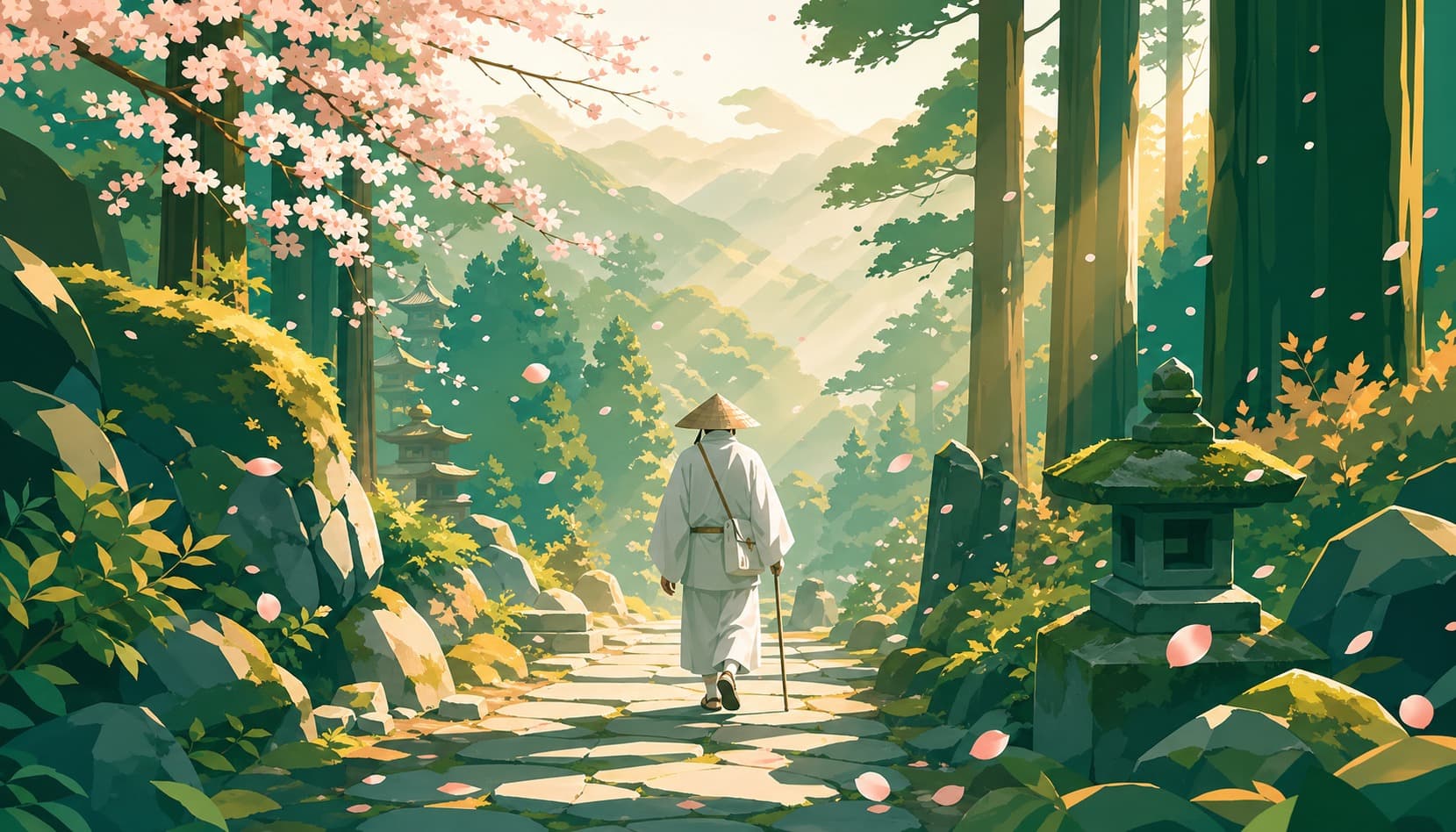
The Shikoku Henro is a 1,200-kilometer circuit of 88 temples encircling the island of Shikoku, birthplace of Kōbō Daishi — the monk who carried Buddhism's esoteric flame from Tang-dynasty China and founded Shingon, reshaping the spiritual landscape of Japan forever. Pilgrims dress in white, the color of death and rebirth, and carry a wooden staff said to embody Kōbō Daishi himself, for the ancient teaching of Dōgyō Ninin — "two walking together" — holds that the great master never abandons those who walk his path. The four prefectures of the island form a sacred geography of the soul: Awakening, Discipline, Enlightenment, and Nirvana, each stage unfolding across cliffs above the Pacific, cedar-shadowed mountain passes, and quiet riverside temples where incense has burned for a thousand years. Pilgrims complete the circuit in many ways — some in white linen on foot over 60 days, others by bus in a fortnight — yet all arrive at the same truth: that to walk Shikoku is to walk in the footsteps of eternity.
Points of Interest
Ryōzen-ji (Temple 1)
· templeStarting point of the Shikoku Henro. Pilgrimage supplies (white coat, walking staff, sedge hat) can be purchased here. Open 6:00–17:00.
Naruto Whirlpools
· viewpointWorld-class whirlpools in the Naruto Strait. Close to Temple 1 Ryozenji. Viewable from the Uzuno-michi walkway below the Onaruto Bridge. Best viewed at spring tides.
Cape Muroto (Kobo Daishi Enlightenment Site)
· monumentSite of the Mikurodo cave where young Kukai (Kobo Daishi) meditated and attained enlightenment. Cape Muroto is Shikoku's southeastern tip with spectacular ocean views.
Cape Muroto Lighthouse
· landmarkWhite lighthouse built in 1899, standing at the very tip of Cape Muroto. Offers panoramic views of the Pacific Ocean. A short walk from the henro trail near Temple 24 Higashidera.
Katsurahama Beach
· viewpointKochi's most famous scenic beach, renowned for moon-viewing. A large bronze statue of Sakamoto Ryoma gazes out to sea. Scenic stop near Temple 30. Known for its pine-lined crescent shore.
Kochi Castle
· monumentOne of Japan's 12 original surviving castles. Close to Temple 30 Zenrakuji and a major Kochi sightseeing spot. Retains its original Edo-period appearance.
Accommodation
Town lodging summary
15 listed staysNaruto
2 stays
Rates vary; record your own price notes.
Kochi
2 stays
Rates vary; record your own price notes.
Matsuyama
2 stays
Rates vary; record your own price notes.
Kamiyama
1 stay
Rates vary; record your own price notes.
Tokushima
1 stay
Rates vary; record your own price notes.
Muroto
1 stay
Rates vary; record your own price notes.
Shimanto
1 stay
Rates vary; record your own price notes.
Tosashimizu
1 stay
Rates vary; record your own price notes.
宿坊 霊山寺(第1番)
Naruto
Rate varies
30 beds
善根宿 遍路の宿 なると
Naruto
Rate varies
6 beds
民宿 徳増(焼山寺登山口)
Kamiyama
Rate varies
15 beds
宿坊 大日寺(第13番)
Tokushima
Rate varies
20 beds
民宿 室戸荘(室戸岬)
Muroto
Rate varies
18 beds
善根宿 土佐のへんろ小屋
Kochi
Rate varies
8 beds
遍路宿 岩本寺前(第37番)民宿 まえだ
Shimanto
Rate varies
12 beds
民宿 足摺黒潮(足摺岬)
Tosashimizu
Rate varies
20 beds
Data source
App bundled data
Lodging data is compiled from multiple sources including temple lodging (shukubō), henro houses, and local accommodation guides. Availability varies by season — always confirm directly.
Showing 8 of 15 · Rates vary; use your own price notes and verify availability directly before your trip.
⚠️ Before You Go
Best avoid
June–July (tsuyu rainy season) and August (extreme heat in Kochi prefecture)
Weather risk
Tsuyu rain June–July; summer heat in Kochi (high 30s°C); typhoons August–September
Mobile signal
Remote mountain sections between Temples 12–23 (Tosa) have minimal signal
Cash
Many temples and rural lodgings only accept cash — carry ¥20,000+ at all times
Note
The full 1,200 km circuit takes 30–60 days on foot; Temple 66 (Unpen-ji) and the Tosa coastal stages are the most demanding
Recommended to carry
Navigate the Shikoku 88 Temple Pilgrimage Offline
Stage-by-stage navigation, waypoint history, and lodging data — all offline in Sacred Trails. Free to download with route packs for the trails you walk.